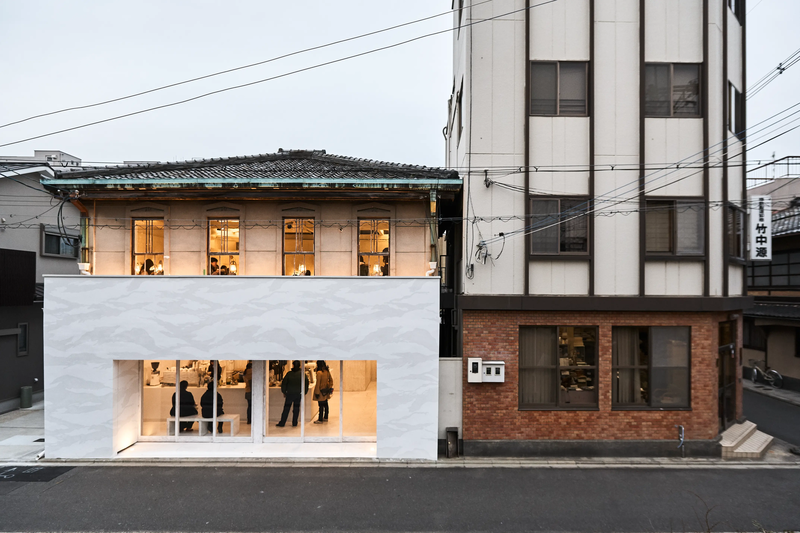
Walden Woods Kyoto
This café opened at the very end of 2017 and quickly became famous for its white 'Instagrammable' design. It was named Walden Woods after the book Walden, or Life in the Woods, although not every influencer is familiar with it. As a result, Kyoto coffee enthusiasts often simply refer to it as 'that white café.'
It's symbolic that the year the café opened marked the 200th anniversary of the birth of the book's author, American writer and transcendentalist philosopher Henry Thoreau. In his autobiographical novel, Thoreau describes the two years he lived as a hermit on the shores of Walden Pond in Canada, to prove that one can be free from material possessions and enjoy a simple life with minimal needs, finding pleasure in everyday tasks rather than the often excessive comforts of civilization.
Although it’s located near Kyoto Station, the café isn't easy to find. However, its owner believes that the surrounding quiet neighbourhoods will become more lively over time. Walden Woods can be found midway between the station and the Higashiyama district. This is yet another allusion to the book: Thoreau's cabin was in a similarly accessible yet secluded area.
The two-story mansion housing 'that white café' was once a shop for 'wedding furniture'—an essential part of the dowry for traditional Japanese brides. Later, during the post-war economic boom and the accompanying business euphoria, curtains and other interior items were sold here. Now, it’s an elegant minimalist space, cleared of all excess in line with Thoreau's philosophy.
During the renovation, the ceiling was removed, turning the wooden beams into an exquisite 'ikebana' in the spirit of the avant-garde Sogetsu school. This impression is further enhanced by a white tree branch adorning the centre of the hall.
All other details seem to dissolve in this radical whiteness—even the floor is white. The only black elements are the barista's clothing and the vintage Probat roasting machine, which the owner miraculously managed to acquire from Germany. The main advantage of this machine is its thick cast iron walls, which elevate the roasting quality to a higher level. To understand the correlation between wall thickness and roasting quality, one might consider how meat cooked on a teppan differs in taste from meat cooked on a regular pan.
Aside from the trendy vintage feel, the unusual layout and wabi-sabi-inspired minimalism are noteworthy. For example, on the second floor, instead of traditional tables and chairs, there’s a square amphitheatre without a strict division between seating and table areas. The steel elements of the lamp shades, combined with the aluminium trays, highlight the colour of the noble beverage like a setting enhances a precious stone.
As you can see, it’s no surprise that Instagram regulars eventually become regulars at this café.
What other specialty elements can be found here, and what should one pay attention to?
The custom-made Slayer espresso machine, assembled by hand, is painted to resemble the building’s facade: subtle grey waves on a white background.
The coffee beans for espresso are a house blend, carefully selected for composition and roast level. For drip coffee, both blends and SO (single origin) beans are used, although sometimes SO is also used for espresso when its shelf life is nearing its end. There are plans to acquire an additional grinder specifically for SO espresso, which will elevate the café to an even higher level.
Masala chai also falls into the specialty category here. Walden Woods is probably the only place in Kyoto where it’s made from scratch—grinding the spices in a mortar, steeping them in frothed milk, and sprinkling cinnamon on top for an aesthetic touch. Upon request, the drink can be prepared without sugar syrup, resulting in perhaps the best chai in all of Kyoto, as sugar tends to oversimplify the flavour.